quinta-feira, 20 de maio de 2010

Paula Rego - Mulher Cão

Para Tânia Correia...


Mulher Cão"[...]
"Mulher Cão surgiu de um esboço feito tendo Lila como modelo e realizado em cinco minutos enquanto pintava no atelier"[...].
A ideia foi despoletada por uma história de fadas que uma amiga portuguesa lhe contara numa carta.Uma história de uma rustividade feroz:
-"Uma senhora de idade ,que vive sózinha com os seus animais de estimação.O vento que sopra pela chaminé soa com a voz chorosa de uma criança, encorajando-a a comer os animais,um após o outro.Tarefa sinistra que ela cumpre conscienciosamente.Põe-se em quatro patas e os animais entram na sua boca.
Paula Rego pediu a Lila "para se agachar e representar uma mulher com a boca aberta,como se estivesse a engolir"
"Quando apareceu a mulher cão foi um grande dia na minha vida,posso assegurá-lo",disse.


Mulher Cão – 1994, encontra-se na Tate Gallery, Londres


domingo, 9 de maio de 2010

Novas apresentações da Cultura ENTRE Culturas e de Uma Visão Armilar do Mundo


UMA VISÃO ARMILAR DO MUNDO

APRESENTAÇÃO DO LIVRO
de Paulo Borges

11 de Maio (3ª) 18h30
apresentação da obra por Risoleta Pinto Pedro
leitura de textos por Bruno Ferro e Luíza Dunas

CULTURA ENTRE CULTURAS
que diálogo entre culturas?

APRESENTAÇÃO DA REVISTA
por Paulo Borges

11 de Maio (3ª) 19h
leitura de textos por Bruno Ferro e Luíza Dunas

Escola Superior de Medicina Tradicional Chinesa*
Palácio da Estefânia
Rua Dona Estefânia, 175
1000-134 Lisboa
(metro Saldanha)

sábado, 8 de maio de 2010

Vollmond - Pina Bausch


Vollmond Pina Bausch Hong Kong Festival filmé par Jérome Cassou

terça-feira, 4 de maio de 2010

Paul Reid

HERMES and ARGUS

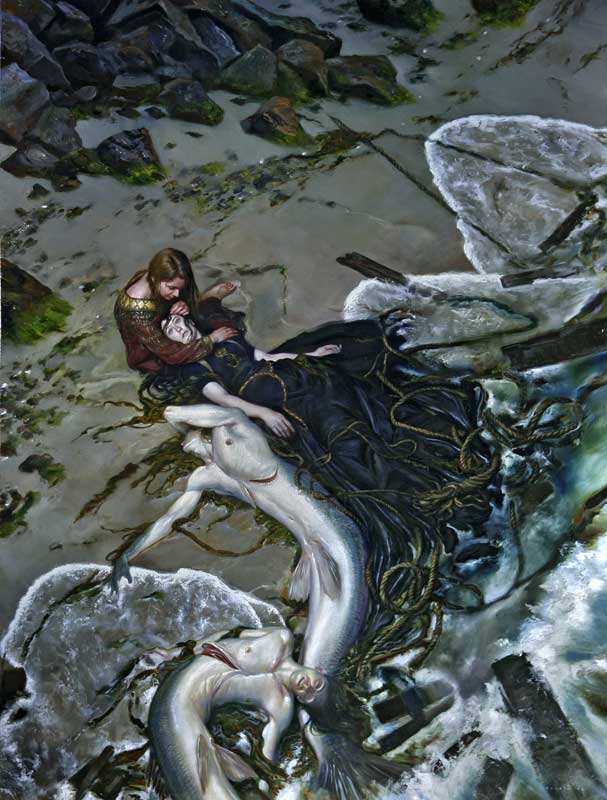
The Heliades


Orion


CAPTIVE MINOTAUR


Odysseus on the Island of Circe


Actaeon (2009)


Theseus and the Minotaur (2009)


Theseus and the Minotaur by Paul Reid, 2006

“Before there was any earth or sea, before the canopy of heaven stretched overhead, Nature presented the same aspect the world over, that to which men have given the name of Chaos”. So begins Ovid’s Metamorphoses, with its mythical tales of the magical transformations of gods and men into animal, vegetable and mineral forms. No classical text has had greater influence on the Western literary and artistic imagination than this collection of sometimes savage stories exposing the existential chaos beneath the surface of civilisation. The fact that we no longer read them could mean one of two things: either we’re too civilised to need them, or we’re in denial. The Greeks had an answer to both in the story of Pentheus, the priggish King of Thebes who doubted the power of the God of Wine, Dionysus, and was torn apart by the God’s frenzied followers, led by his mother.

Appropriately, this story is the subject of a painting by Paul Reid, the young Scottish artist described four years ago by Guy Peploe as “one of the most exciting painters to emerge from the primordial broth of postmodernism”. For the past eight years, Reid has been painting mythological subjects left untouched for more than a century. While his contemporaries, crushed by the weight of art history, have chosen the postmodern way out, Reid has opted to play Atlas and shoulder the burden – a decision which, in art critical terms, makes him as much a freak of nature as the prodigies he depicts.

Paul Reid was born in 1975 on the industrial estate of North Muirton, Perth, moving in his early teens to Scone. There were no artists in his family, although his mother could draw and used to amuse him with pictures of Superman. As a boy, he learned his first lessons in anatomy from the musculature of comic book superheroes: “When it came to life drawing,” he recalls, “I knew where everything went”. At Duncan of Jordanstone College of Art in Dundee he painted still lifes and portraits, without quite knowing where they were taking him. It was while looking at Rubens and Titian that he became curious about the names of the characters in their paintings, and decided to investigate. He began with Ovid. “It was amazing,” he says. I opened the pages, and there were hundreds of paintings waiting to be painted.”

The fact that none of his tutors knew the myths was of course a problem and, in the current conceptual climate, he was given a hard time. But he persevered, and for his graduation work painted his first ambitious mythological set piece of The Death of Actaeon. He graduated with a First Class Honours in 1998, won a John Kinross Travel Scholarship and left for Madrid and Florence to continue his mythological art education. Other classical subjects followed – Pentheus, Marsyas, The Heliades, Hermes and Argus, Orion, Endymion, Theseus and the Minotaur – touching on themes of intellectual pride, overreaching ambition, the quest for eternal youth, the monstrous consequences of unbridled desire. He has not been tempted by more modern sources: “There’s plenty enough in classical myth,” he says.


Reid is a classical painter not simply in his choice of subjects: he is also a picture maker in the old-fashioned sense. Picture-making, for him, isn’t just about composition; it’s a process that begins from the ground up. Since his student days, when he discovered Max Doerner’s classic manual on old master techniques and read it “from cover to cover, like a Bible”, he has made his own grounds and mixed his own colours. When I visited his studio during the painting of Odysseus on the Isle of Circe, figures in traditional black and white grisaille were taking shape on a deep red ground, with a thicket of green trees growing up around them. “I tend to fit the landscape around the figures,” he told me. At this stage in a picture’s development the iconography has been plotted but the painting process remains fluid.


In the case of Odysseus, Reid had decided to depart from Homer’s version of the story, which has the hero land on the enchantress’ island to find that earlier mariners have been turned into swine. He preferred a version on an Attic black-figure cup showing Circe’s captives as men with different animal heads. Returning to original sources can suggest new ways of treating old stories: his unusual idea of a resting minotaur was based on Apollodorus’ account of Theseus discovering the monster asleep (although the composition owes m ore to Velasquez’s painting of a groggy Mars the morning after the night before with Vulcan’s wife). Ancient sources are fleshed out with contemporary visual references: the gorilla-head of one captive mariner is modelled on a live example in Edinburgh Zoo, the goat horns of another on a stuffed specimen in the museum of Natural History. For the human figures, Reid draws on his friends: “I trade on their vanity,” he says. (He doesn’t include his enemies: ”They wouldn’t pose”.)


The figures start semi-naked and are gradually clothed as items of their wardrobes are pieced together. Props are improvised from odds and sods – Odysseus’ sword was cobbled together from a pepper grinder and a wok handle, wound around with leather: a domestic exercise in metamorphosis. “I only need to see where the reflections hit,” Reid explains. “There’s a lot of stage setting involved; it can take the best part of a day to get the fall of the drapery right. Sometimes it can be incredibly frustrating building a painting, because you can’t just go into the studio and say: “I feel inspired today’. But problem-solving is what I enjoy.”


The process is fascinating, the results are extraordinary, but some viewers will still ask the question: why? Does the world Reid recreates in his studio have any relevance at all to the one we live in? The answer has to be yes, or he wouldn’t paint it: every artist necessarily belongs to his age. But although Reid is conscious of the topical relevance of some of his subjects – the genetic experiments of Circe, to take an obvious example – he has no inclination to spell it out. “Painting is a pictorial art,” he says. “If I have a picture I want to paint, I don’t feel I have to justify it with a conceptual blurb”. Sometimes the physical challenge of the subject is enough; he’s tempted by the idea of painting Sisyphus, “because that would be a great thing for the pushing and the exertion”.

It would also be a potent metaphor for the uphill struggle of a solitary artist against the prevailing trend. But it would be a mistake to represent Reid as a fogey, a reactionary on a neoclassical mission. To neoclassical tastes, he’s not classical enough. His refusal to idealise the human figure, leaving features and physiques so identifiable that you recognise the same model in different pictures, is irredeemably naturalistic. His compositions may conform to classic models – the frieze-like design of a picture like Odysseus on the Isle of Circe goes back, via Velasquez, to Roman sarcophagi – but his protagonists are contemporaries in classical dress.


The all-over lighting of his interiors, so obviously electric, heightens the feeling that the action is a tableau staged for our benefit, and that as soon as we’re gone the director will cry ‘Cut!’ and the actors will slip back into trainers and jeans. To a neoclassical sensibility, this slippage between the real and the ideal may grate like a grinding of aesthetic gears, but for the rest of us, the conflict lends the work interest. “I’m too much of a Northern artist to be a classical painter,” says Reid. “I’m too interested in the faces. If you’re an arch-classicist and you try to make each person an everyman, it becomes very boring.” To Reid’s eye, physical truth is too compelling: “I’m honest when I’m painting. I don’t like to lie too much.”


Reid’s reluctance to lie has tied him to his native landscape, which forms an unlikely backdrop to classical scenes normally set on the sun-kissed slopes of the Mediterranean. It’s a surprise to see the blinded giant Orion striding towards the rising sun across Scottish scenery that might have been painted by Peter Graham, Alexander Fraser or any of the 19th century landscapists in the collection of the National Galleries of Scotland. Reid has never consciously studied these paintings but, as he points out, he has studied the same landscapes. Again one senses a tension between the demands of truth and the demands of picture-making; while he loves the stage set quality of Poussain’s landscapes, he knows it would be “utterly unrealistic” to go looking for it in the real world. Nor is he tempted to incorporate into his pictures the genuinely dramatic landscapes he sketched at Petra and Wadi Rum while travelling in Jordan with the Prince of Wales in 2004. “ The Wadi Rum landscapes were too ‘Wow!’. What I lik about the Scottish landscape is that real wildness, and the colour.”


Reid’s honesty and his insistence on keeping it real have made him suspicious of the moral claims sometimes made for art. A review of the recent Velazquez show in London which compared the painter’s surface effects with his ‘inner truth’ made him bristle. To Reid, the business of painting is about appearances; what an audience sees beyond them is their own affair. If there’s an inner truth to his work, he’s not letting on. The myths of antiquity have retained their power over us because their meanings are open-ended; Reid’s pictures operate on the same principle. It augers well for their longevity.

Laura Gascoigne (2007)

http://www.dundee.ac.uk/museum/djc/paulreid.htm

domingo, 25 de abril de 2010

2º Encontro de Jovens Investigadores do CEAUCP – CAM

2.º ENCONTRO DE JOVENS INVESTIGADORES DO CENTRO DE ESTUDOS ARQUEOLÓGICOS DAS UNIVERSIDADES DE COIMBRA E PORTO - CAMPO ARQUEOLÓGICO DE MÉRTOLA (CEAUCP-CAM)
Com participação do GEMA (Grupo de Estudos Multidiciplinares em Arte/ Universidade de Coimbra)

Faculdade de Letras da Universidade do Porto, Anfiteatro 1

Sexta Feira, 9 de Abril

9:00 h – Sessão inaugural

9:20 h - Cláudio Torres
Linhas de trabalho do Grupo de investigação sobre Arqueologia e espaços em época medieval e moderna

9:40 h - Joana Valdez
Arte Rupestre do Monte de Góis (Lanhelas, Caminha)

10:00 h - Duarte Frias
Nicolau Nasoni (1691-1773) - do Efémero à Teatralidade, da Pintura Decorativa à Arquitectura

10:20 h - André Moreira Tomé
Práticas Mortuárias no Norte da Mesopotamia: continuidade e mudança ao longo do 3º e 2º milénio ANE

10:40 h - Miguel Serra e Eduardo Porfírio
O povoado do Bronze Final do Outeiro do Circo (Mombeja, Beja). Balanço de 2 anos de investigação

11:00 h - Descanso

11:20 h - Lígia Rafael
Os Trinta Anos do Projecto Mértola Vila Museu: Balanço e Perspectivas

11:40 h - Lídia Maria Gonçalves Baptista
Trabalhos arqueológicos nas Bacias Hidrográficas das Ribeiras do Pisão e do Álamo (Beja): contributos para a discussão da Pré-História Recente do Interior Alentejano e das suas condições de pesquisa

12:00 h - Paulo Almeida Fernandes
Uma arte incompreendida: o pré-românico hispânico no Ocidente peninsular (711-997)

12:20 h - Almoço

14:00 h - Raquel Vilaça
Linhas de trabalho do Grupo de investigação sobre Arqueologia da Lusitânia: estruturas e dinâmicas

14:20 h - Eduardo Porfírio e Miguel Serra
Rituais funerários e comensalidade no Bronze do Sudoeste. Novos dados a partir de uma intervenção de emergência no sítio de Torre Velha 3 (Serpa)

14:40 h - Mathieu GRANGÉ
Povoamento rural e metalurgia do ferro no Baixo Mira entre a Antiguidade tardia e o período islâmico. Balanço provisório das investigações em curso

15:00 h - Alexandra Maria Ferreira Vieira
Paisagens – lugares de Memória

15:40 h - Lara Bacelar Alves
Imagens fixas… ideias soltas! Algumas reflexões sobre os contextos sociais e culturais da arte holocénica em Portugal

16:00 h - Paulo M. Campos de Lima
Novos métodos de registo digital de arte rupestre: fusão de varrimento 3D com fotografia multi-espectral.

16:20 h - Isabel de Moura Anjinho Marques dos Carvalhos
O desenvolvimento de uma tese: ”A fortificação de Coimbra, das origens à modernidade“

16:40 h - Descanso

17:00 h - António José Marques da Silva
Resultados de escavação arqueológica do Castro do Vieito (Perre, Viana do Castelo)

17:20 h - Ana Carina Marques Dias
O Adufe, contexto musicológico e histórico

17:40 h - Ângela Carneiro

A cerâmica do sítio do III e II milénios a. C. de Castanheiro do Vento (Vila Nova de Foz Côa)

18:20 h - Agustín Ortega Esquinca
“Cerro das Oliveiras” un asentamiento rural de la Mértola islámica

18:40 h - Sérgio Alexandre Gomes
A Arqueologia e o Estado-Nação

19:00 h – Maria José Bento
Convento de Cristo – 1420/1521 – mais do que um Século

19:20 h - Marcela Inés Rucq
A sombra como matéria. Projecção e projecto na fotografia e o cinema

19:40 h - Alessia Amato
Elementos concernentes a arqueologia do meio aquático no Garb al-Andalus: algumas considerações

20:00 h - Maria Pilar Reis
Latrinae e Foricae em Conimbriga. Gestão de resíduos urbanos

Sábado, 10 de Abril

9:00 h - Maria Jesus Sanches
Linhas de pesquisa do Grupo de investigação sobre Pré-história recente e protohistória: territórios e espaços em Trás-os-Montes e Alto Douro

9:20 h - António Martino Venhuizen Correia
Estelas e estátuas-menir no Centro e Norte de Portugal

9:40 h - Ricardo Figueiredo Cabral
Controlo e circulação nos espaços urbanos do IIIº milénio no Norte Mesopotâmia

10:00 h - Sandra Cristina da Costa Fialho Palma Cavaco
O arrabalde da Bela Fria. Contributos para o estudo da Tavira Islâmica

10:20 h - Joana Castro Teixeira
Gestos, "motivos", "padrões", algumas reflexões em torno da análise do "modo de fazer e transmitir" na Pré-História Recente

10:40 h - Mariana Pereira
A interpretação dos materiais arqueológicos: os chamados “pesos de tear”

11:00 h - Joana Antunes
Uma Epopeia entre o Sagrado e o Profano – desenvolvimento de uma tese de Mestrado sobre o Cadeiral de Santa Cruz de Coimbra

11:20 h - Descanso

11:40 h - Lurdes Craveiro
Linhas de trabalho do Grupo de investigação sobre Estudos Multidisciplinares em Arte

12:00 h - Carlo Emanuele Bottaini
Novo contributo para a caracterização e contextualização do "achado da época do Bronze de Vila Cova de Perrinho - Vale de Cambra" 50 anos após a sua descoberta

12:20 h - Ana Margarida Vaz

Arquitectura Helenística do sector C de Tell Beydar - Síria

12:40 h - Vera Lúcia Almeida Magalhães
Hospital e Poder. Do Absolutismo ao Liberalismo. Apresentação de um tema

13:00 h -Ana Margarida Aparício do Vale
O sítio arqueológico de Castanheiro do Vento (Horta do Douro, V.N. de Foz Côa). Arquitectura e materiais: escalas de relação

13:20 h - Ana Cordeiro de Sousa Gomes Abrunhosa
O contributo da arqueometria no estudo da composição e processos de fabrico das contas de vidro da estação arqueológica Crasto de Palheiros (Murça-Vila Real)

13:40 h - Maria Luísa de Castro Vasconcelos Gonçalves Jacquinet
O Mosteiro do Louriçal no quadro do mecenato artístico de D. Pedro II e D. João V

15:20 h - Almoço

15:40 h - Conceição Lopes
Linhas de trabalho do Grupo de investigação sobre Arqueogreografia

16:00 h - Ana Bicas
Cerâmicas do Bronze Final do Castelo de Arraiolos - Um estudo petrográfico de lâminas polidas

16:20 h - Tiago Marques da Costa

Cerâmica Helenística do sector C de Tell Beydar – Síria

16:40 h - Miguel Reimão Costa
Um método para o estudo da arquitectura da vila e do termo de Mértola

17:00 h - Dulcineia Cândida Bernardo Pinto
Revelações sobre a cultura material: Como um conjunto cerâmico conta uma história de estratigrafia

17:20 h - Descanso

17:40 h - Joana Alves Ferreira
Origens, Fantasias e “Estórias” bizarras. O arqueológo como um narrador trágico

18:20 h - Inês da Conceição do Carmo Borges
Arquitectura Senhorial: matriz da Sociabilidade, do Poder e da Cultura em Lamego

18:40 h - Margarida Donas Botto

A arquitectura de matriz portuguesa de Maputo nas décadas de 20 a 50: uma abordagem

19:00 h - Filipa Maria Cristóvão Medeiros
A historiografia medieval portuguesa hoje: temas e problemas. Uma representação taxonómica

19:30 h - Maria Armanda Palma Salgado
Marketing nas bibliotecas universitárias portuguesas

20:00 h - Reunião Plenária do CEAUCP

20:30 h - Encerramento