Born in 1968 in Poznan, Poland. 1989 - 1994 studied painting at the Academy of Fine Arts in Cracow, under Prof. Juliusz Joniak, and 1995 - 1998 studied photography, under Prof. Zbigniew Lagocki. Chrobak's paintings have been shown in various galleries throughout Poland, Italy, Austria, and Holland.
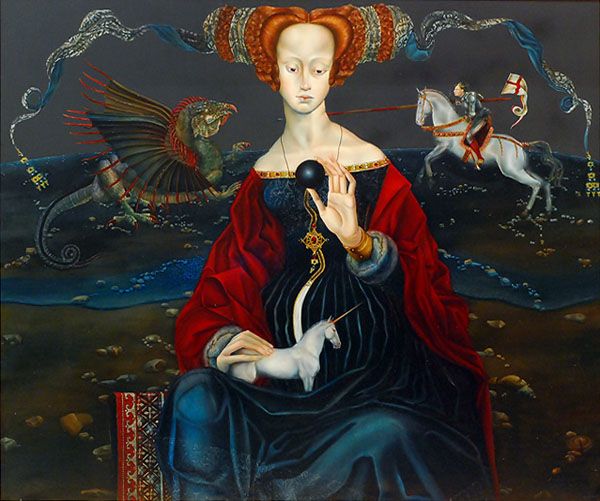
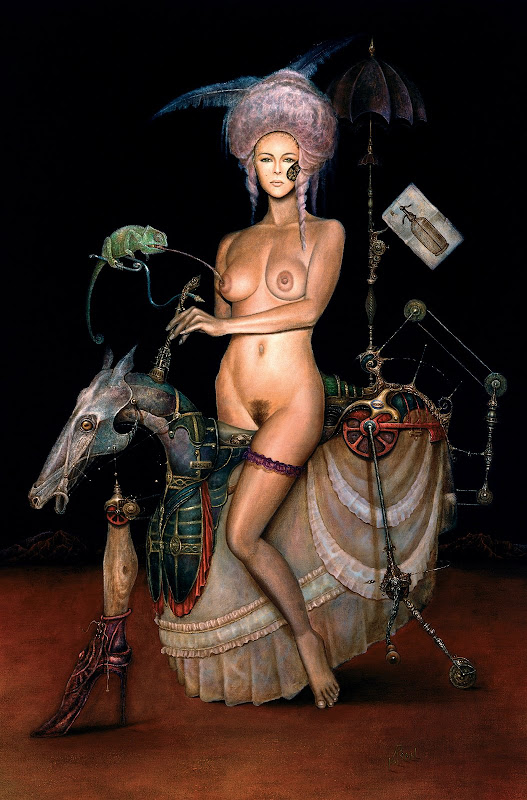
An artist of transcendental intimacy When perceiving the artistic creation of Frank Kortan we are down, if we want to apply the methods and clichés of classical art history. We have to turn to the newest spiritual and theoretical conceptions from various fields of anthropology. We are led to it by honest intentions to get into the aesthetics of Frank Kortan. The inspirations of artistic creation of this painter are near to the surrealistic aesthetics of free imaginations and associations, the experience of subconscious and nonconscious defined by Freud. But not everything created by Kortan can be explained in this way. According to him antitheses cease to be "real or imaginative"; he is a follower of the relativity of existence. When contemplating of Kortan's artistic creation we remember the words of André Breton from the Second Manifesto of Surrealism. He says that the aim of a surrealistic activity is to define "a certain spiritual point from which life and death, real and imaginative, past and present, notifiable and unnotifiable, high and low cease to be perceived as antitheses." Kortan's everyday motives express his love of dreaming which has been named "via regia" - nonconsciousness. Nevertheless, we cannot confine the perception of Kortan to classical psychoanalysis. It seems to us that the most thruthful are concepts, which Gaston Bachelard applied in his Phenomenology of Dreaming where he distinguished the values of dream. In this respect Kortan is a master of absolute dream and half-dream. In his paintings full of "old" and "new" eternity we register something, which is named "dreaming about dreaming". Kortan's absolute dream of a night sleep is in fact a Universe. We acquaint with Kortan's animism: nothing is death in his still lives - everything is live. The activity of subconsciousness is evident: one motive is replaced by another; psychical accents are transferred to other ones. Aesthetic condensation defined by psychoanalyses is substantial: two - or more - imaginations combine and create more complex imagination with deeper meaning and stronger energy. We register out-of-sensuous perception, especially the transfer of aesthetic meanings. As a matter of fact, Kortan is one of world avant-gardists because his paintings are near to "individual mythology" which is focused on the retrospective classification of the past and inspired by the "tracks of human civilisation" and which emphasises "the re-vitalisation of fragments". While Anne and Patrick Poirier look for archeological inspirations, Nikolaus Lang depicts the atmosphere of a Bavarian family and Jürgen Brodwolf paints miniature shop-windows, Frank Kortan confines himself neither to a metaphor nor a concrete event. We have to point out to Kortan's aesthetics, which reflects the out-of-sensuous psychology of C.A.Mace who presupposes the existence of a "psychical ether" through which the waves of thought spread and in which the tracks of events remain. In addition, the aspect of temptation is presumed. If he did not admire the symbolic-sexual aspects of a woman nude, he would not be a surrealist. Nevertheless, in his artistic creation these aspects oscillate between latent, evident and mysterious. These are the symbols of woman. As noncousciousness follows the principles of delight and not reality - as we know from psychoanalysis - Kortan expresses the eternity of delight. He reminds the words by Nietzsche on his tablet in Sils-Maria See in Upper Engadin: "Every delight is eternity". Kortan invites to introspection and purification from the sentimentality of civilisation. He wants a man to be immune against any tie resulted from work and the world of things. In this respect he is "transcendental". In this respect we can cite an idea from Indian spiritual culture: "A work which does not cause any tie is a work with transcendental result, i.e. karma-yoga." Kortan does not aim at the Absolute Personality of the Deity: he represents a happy soul and wants everybody to be like him ...Prof. Dr. Miroslav Klivar, member of The American Society for Aesthetics
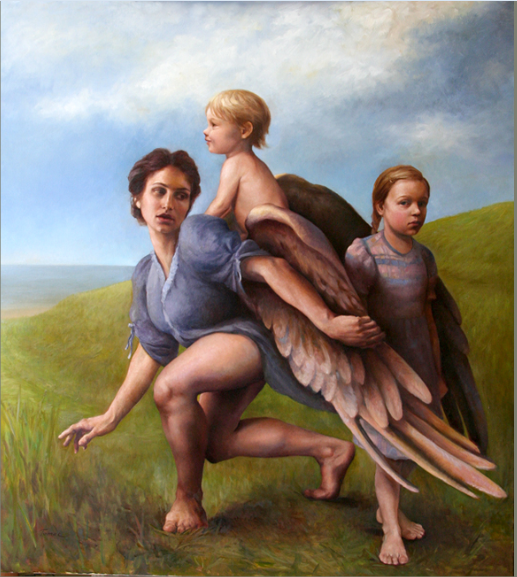
Sanna Tomac has painted all her life, but moved by the war in Croatia, she became a Red Cross registered nurse in 1995. She studied drawing and painting at the Florence Academy of Art, in Florence, Italy from 1996-1998 and afterward studied with the painter Odd Nerdrum in Norway. In 2001, along with her husband Hans-Peter Szameit, she founded Pantura Studios in the United States where together they taught a growing group of students who came from across the country and abroad. In early 2006 they moved to Stockholm, Sweden and founded The Swedish Academy of Realist Art/Atelier Stockholm (www.atelierstockholm.se), the first school of its kind in Northern Europe. Her paintings and drawings can be found in public and private collections throughout the world.
Du 14 septembre au 12 décembre 2010, Grands Appartements et Galerie des Glaces, inclus dans le parcours de visite. Parterre d'eau : accès libre (sauf les jours de Grandes eaux).
5 œuvres de l'exposition décryptées par OTTO OTTO, le gardien de l'art contemporain incarné par Tom Novembre, décrypte 5 œuvres de l'exposition Murakami. OTTO est diffusé sur Paris Première et TV5 monde.
Flower Matango 2001 - 2006 (Fibre de verre, fer, peinture à l’huile et acrylique) Œuvre présentée dans la galerie des Glaces
Kaikai & Kiki 2000 - 2005 (Fibre de verre, fer, résine synthétique, peinture à l’huile et acrylique) Œuvre présentée dans le salon de Vénus
Oval Buddha 2007 - 2010 (Bronze et feuilles d’or) Œuvre présentée sur le parterre d'Eau
Superflat Flowers 2010 (Fibre de verre, plastique, fibre de carbone, acier et peinture acrylique) Œuvre présentée dans le salon de la Paix
Yume Lion (The Dream Lion) 2009 - 2010 (Aluminium et feuilles d'or) Œuvre présentée dans le salon d'Apollon